Missouri is Invested in the Future of the Geospatial Industry
Massive corporations like Boeing, Bayer, and Enterprise Holdings are already part of the geospatial ecosystem in Missouri, delivering solutions for the federal government and private industry around the world.
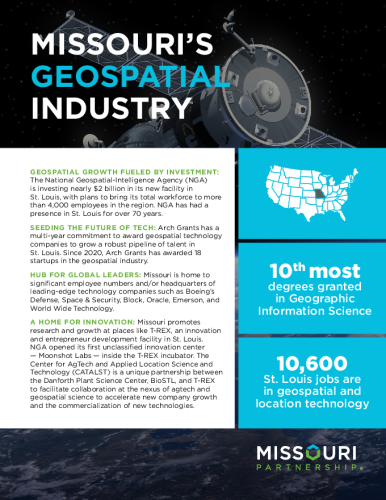
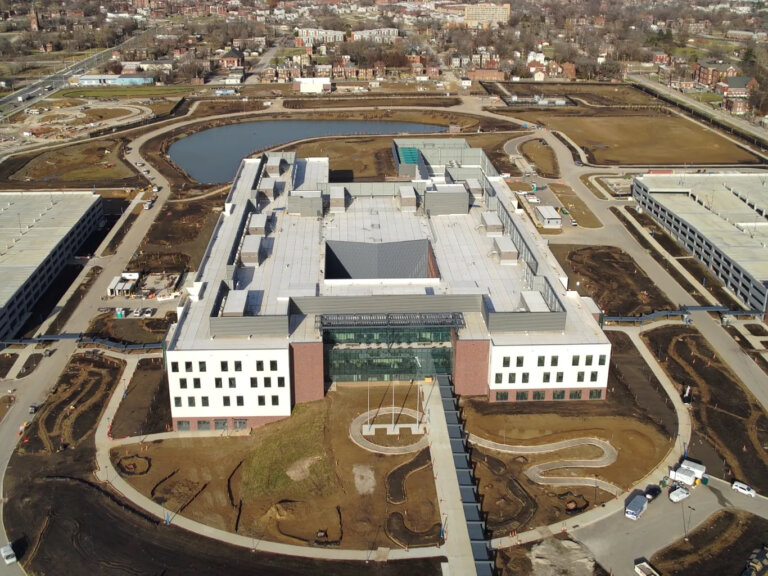
The National Geospatial Intelligence Agency (NGA) has invested $1.75 billion in its new West HQ facility in Missouri. NGA has had a presence in Missouri for more than 80 years.
“St. Louis is becoming the geospatial technical hub not only of the nation, but of the world.”
Vice Admiral Robert “Bob” D. Sharp, director, National Geospatial-Intelligence Agency
According to a report by TEConomy Partners, LLC, a development research firm, the geospatial industry in St. Louis alone supports 27,000+ direct and indirect jobs with a total economic impact of $4.9 billion.
Eight research institutions have joined forces to form the Taylor Geospatial Institute, advancing St. Louis as a leading hub for geospatial research, collaboration, and innovation. Building on this momentum, GeoSTL is further aligning industry, academia, and government partners to accelerate growth and strengthen the region’s geospatial ecosystem.
Cultivation Capital has launched a $50+ million fund focused on geospatial technology, further fueling startup growth and commercialization in the region.
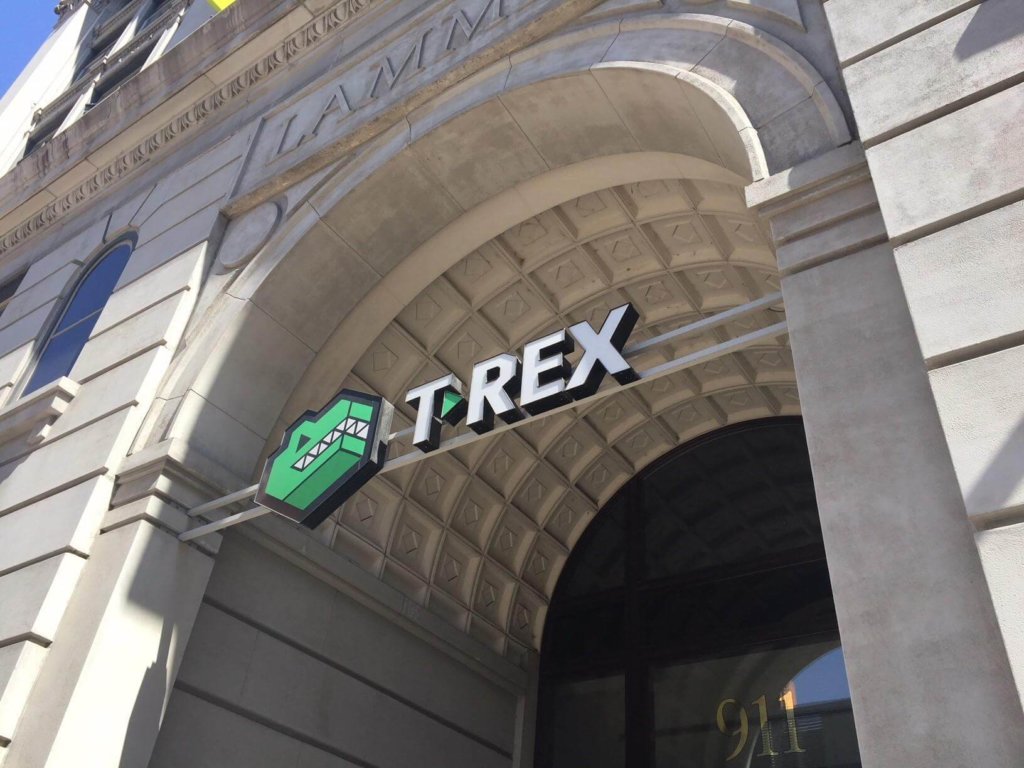
T-REX in St. Louis
At T-REX, the Geospatial Innovation Center, powered by Bayer, offers 16,000 sq. ft. of collaborative workspace dedicated to advancing Missouri’s geospatial community. The National Geospatial-Intelligence Agency has also established its first unclassified innovation center, Moonshot Labs, within T-REX. In addition, Harris-Stowe State University’s GeoHornet Lab serves as both an operational hub for its NGA partnership and a career launchpad for geospatial talent.
The recently formed GeoSTL connects industries with location-based technologies to attract talent, accelerate innovation, and drive economic growth.
Missouri is Where Geospatial Companies Connect
St. Louis hosted the GEOINT Symposium, organized by USGIF, in 2021, 2023, 2025 and will do so again in 2029. The conference brings in roughly 4,000 attendees each year and is the largest annual geospatial conference in the U.S.
Reston, Virginia-based Leidos partnered with St. Louis-based Gateway Global American Youth and Business Alliance Academies Inc. (GGAYBA) to support its Entry to Executive program, which prepares students for entry-level positions in the geospatial industry. The program, which provides training in geographic information systems and geospatial intelligence, seeks to place students in apprenticeship and internship positions. Other industry partners of GGAYBA include GDIT and ESRI.
NGA has also partnered with LaunchCode, a non-profit that places aspiring programmers in tech apprenticeships and jobs, to facilitate effective workforce development.
Missouri Has Talent for Geospatial
Rung for Women, in partnership with Maryville University and geospatial employers T-Kartor USA, Maxar, and L3Harris, offers a Geospatial Analyst Training Program that provides students with the knowledge and skills employers seek in entry-level geospatial jobs.
The University of Missouri Columbia has a Geospatial Intelligence Certificate Program that has received accreditation from the U.S. Geospatial Intelligence Foundation. The University of Missouri is also home to the Center for Geospatial Intelligence (CGI), the first academic organization to join the USGIF and the first to exhibit at the annual GeoINT Symposium.
The University of Missouri—St. Louis (UMSL) and NGA formed a partnership in 2021 to prepare students for careers in geospatial intelligence. UMSL is also home to the Geospatial Collaborative, which supports research, technological innovation, and community engagement to support policymakers.
Look Who’s Already Here:
What Missouri Can Do for You
Missouri’s geospatial industry is advancing rapidly, supported by skilled talent, cutting-edge technology, and strong collaboration between public and private sectors.